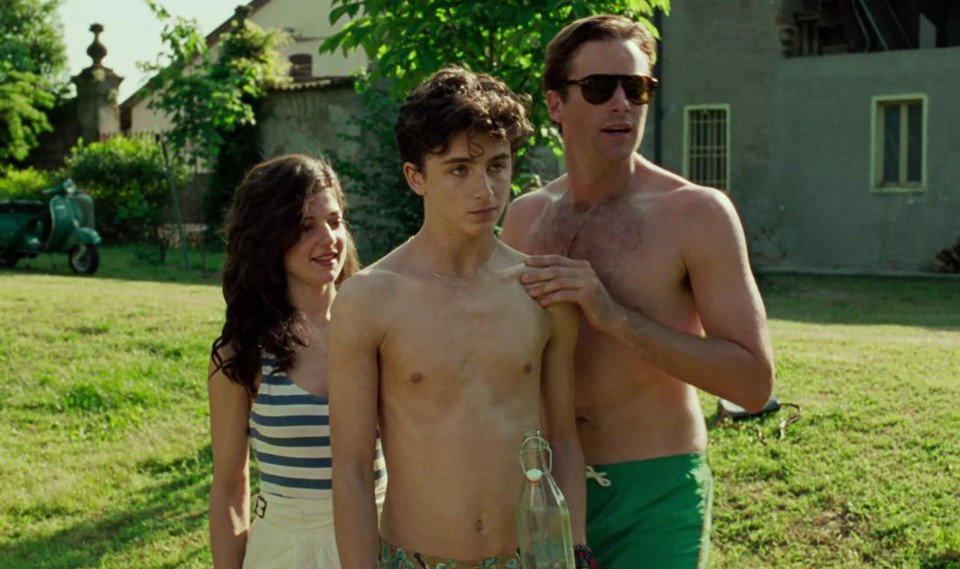
Elio Perlman, Oliver, and Marzia at the Perlman house. Image credit to Sony Pictures Classic.
Imagine a summer at your professor parents’ cabin, spent exclusively enjoying the sun and nearby river, and, inevitably in this romantic Italian frame, falling in love with people around you. This is the story of Call Me by Your Name, a novel by André Aciman, which was recently adapted into a movie by James Ivory, directed by Luca Guadagnino, and starring Timothée Chalamet and Armie Hammer. Although the novel and movie are both prodigious artistic creations, the movie made it the furthest in mainstream culture, gathering four Oscar nominations and one win. Why all this attention? Did this relatively low-budget feature film deserve the fame?
Set in Northern Italy during the post-punk era of 1983, this movie tells the story of Elio Perlman, a talented pianist for his seventeen years of age, and his conflicted feelings for Oliver, an American student who is doing an internship for archaeology professor Mr. Perlman, Elio’s father. They go from being strangers to acquaintances to enemies to lovers in the span of six weeks, and are then wrenched apart by Oliver’s return to the United States. At the end of the movie, Elio learns by phone that his ex-lover is getting married in the spring. The film ends on a heart-wrenching four-minute scene where Elio is seen silently crying in front of the fireplace as his mother and their maid set the table in the background.
The music used in the movie was an essential element in creating the atmosphere. Songs such as “Love My Way” by The Psychedelic Furs and “Paris Latino” by Bandolero were well chosen to remind those who lived them of the eighties in Europe, while new songs by Sufjan Stevens wrapped the experience in so many mixed emotions : hope, nostalgia, grief, pain, etc. To me, this was the cherry on top of a romantic, heartbreaking, and fun sundae. It added to the vibe that was already set in the book and helped the movie go above expectations.
Furthermore, the acting in this movie was so genuine. Every single scene realistically represented the good and the bad of a teenage relationship; the awkwardness, the flirtatious confusion, the glances of complicity. There was not one moment that felt exaggerated, staged, or romanticized like many Hollywood teenage romance movies. This was also helped by the fact that many of the lines were worded incredibly well. Many dialogues were taken directly from the book, which was a great decision on James Ivory’s part as André Aciman is a wonderful author who, in this particular book, really focused on the emotions conveyed and the character development through very little speech. However, some scenes, such as the last one, contain no dialogue and the emotions are just as present. Overall, the actors’ performances were simply astounding.
So, after all, did the movie deserve the attention it got? In my humble opinion : yes, absolutely! The Oscar nominations it got for Best Actor and Best Original Song were completely justified as Chalamet and Stevens conveyed their message to the audience beautifully. As for its win in the Best Adapted Screenplay category, as I mentioned earlier, some scenes were taken directly from the book then played by amazing actors and directed by an amazing director ; what else could you want? Now, Call Me by Your Name may not have won the Oscar for Best Picture, but it is still a movie I recommend to absolutely anyone out there, with André Aciman’s novel accompanying your journey. Ultimately, this coming-of-age story is one to make the older ones nostalgic about their innocent youth and younger ones dream of what thrilling love stories their future might hold.
Comments
Post a Comment